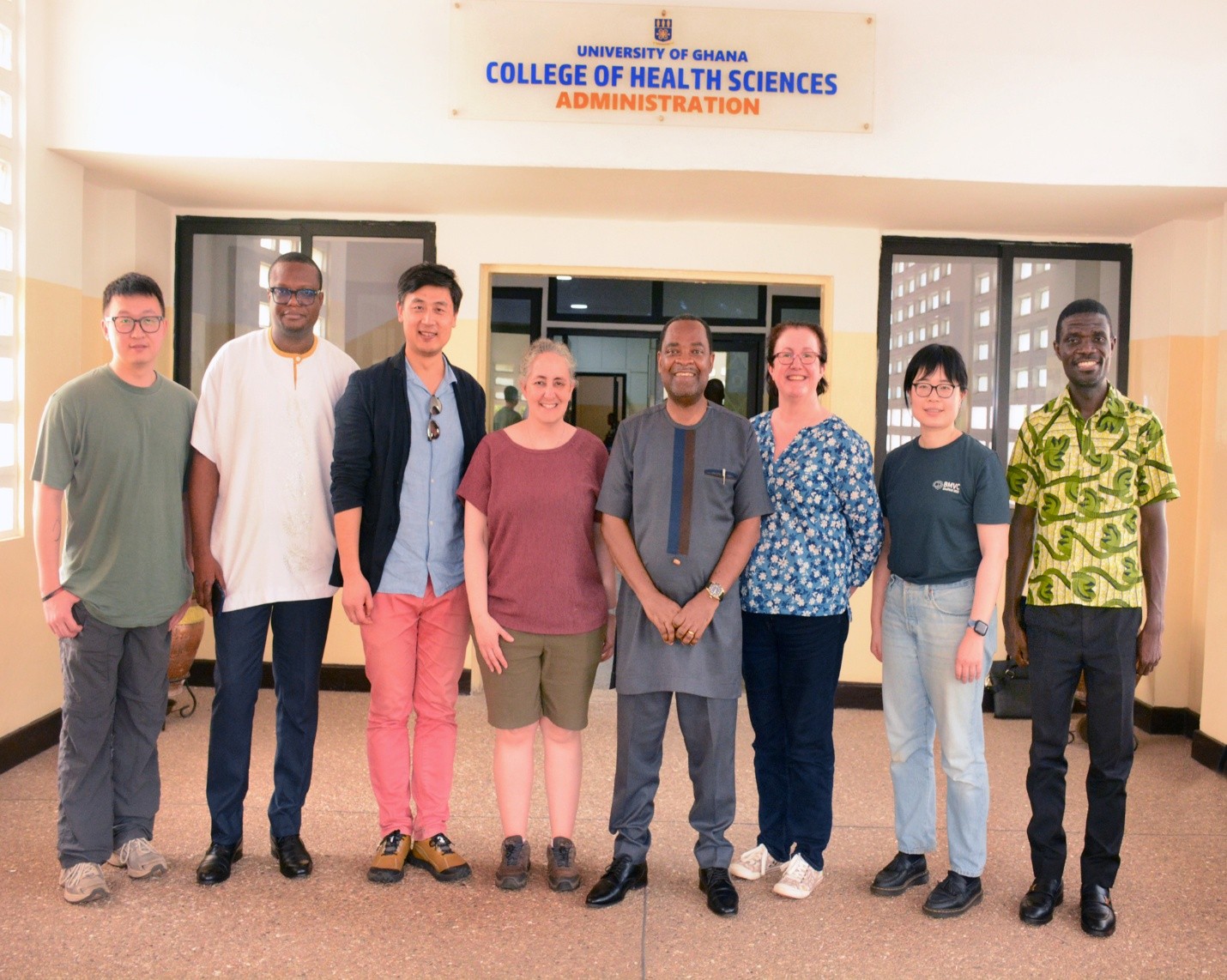
A delegation from the Sheffield University met with Management of the College of Health Sciences to reflect on the outcomes of Artificial Intelligence (AI) Health workshop programme and chart a path for sustained partnership.
The meeting focused on strengthening collaboration beyond one-off engagements. Participants emphasized the importance of continuous dialogue and long-term engagement to ensure that ideas developed during the workshop translate into practical, and measurable impact. Faculty from Sheffield University expressed admiration for the ambition, passion, and drive demonstrated by researchers and students of the University of Ghana, noting the strong foundation for future joint initiatives.
A central theme of the discussions was bridging the gap between research, clinical practice, and service delivery. While acknowledging the wealth of available data, participants noted that measurable impact remains a challenge. The group stressed the need to improve how research findings are communicated to patients and communities and to actively empower patients as partners in their healthcare journey. There was broad agreement that future projects must be designed with clear impact pathways in mind, ensuring that innovations move beyond theory into practical application.
The meeting explored strategies for introducing and scaling innovation within clinical settings. Participants proposed starting with individual clinician “champions” and gradually expanding adoption across departments. Education and practitioner engagement were highlighted as critical to ensuring sustained integration of new approaches.
Feedback from the workshop evaluation provided significant benefits, including stronger internal networking, exploring speech recognition technologies for local languages and AI applications tailored to local healthcare contexts across departments. It was observed that there was a growing interest in artificial intelligence (AI) without clear learning pathways. Overall, participants responded positively to these practical demonstrations, which helped translate complex technologies into meaningful, locally applicable solutions. There was strong interest in developing structured communication platforms that would allow researchers to share problems, test solutions collaboratively, and build sustainable innovation pipelines.
Some opportunities identified include establishing sustained partnership frameworks, developing exchange modules and joint academic programmes, engaging national science bodies to scale initiatives, and expanding research in AI, speech recognition, and motion analysis tailored to local challenges.
The engagement concluded on a high note, with delegation from Sheffield University expressing enthusiasm for the partnership and confidence in its potential to drive impactful healthcare innovation, strengthen knowledge exchange, and build lasting international collaboration.