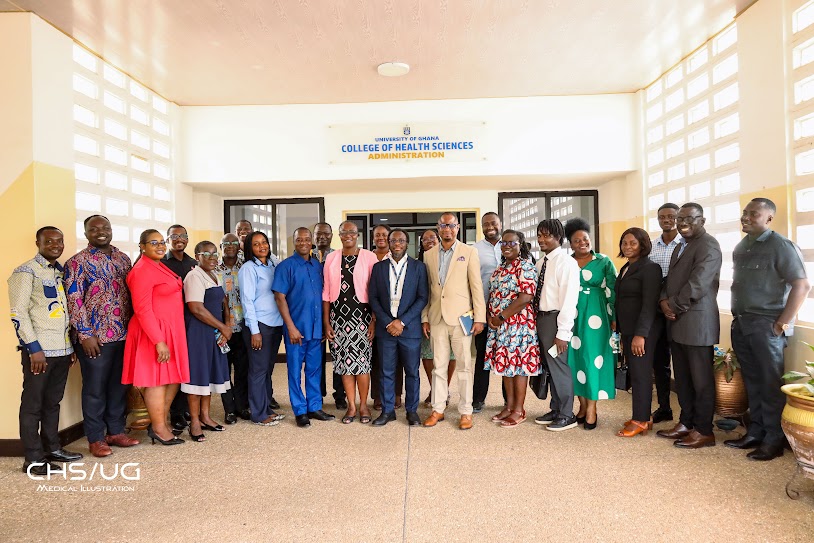
The College of Health Sciences (CHS) at the University of Ghana convened a stakeholder engagement session on Wednesday, 11th November 2026, bringing together representatives from its constituent schools, academic departments, and administrative units to deliberate on the development and rollout of a new Enterprise Resource Planning (ERP) system designed to automate and integrate institutional operations.
The forum provided a critical platform for the project implementation team to brief key internal stakeholders on the strategic objectives, scope, and phased rollout of the proposed digital infrastructure, while actively soliciting user input to ensure the platform aligns seamlessly with the unique operational realities of the College.
Delivering the technical presentation, Dr. Prince Alvin Ansah, a faculty member in the Department of Computer Science and a consultant on the project, explained that the initiative is engineered to establish a centralised digital ecosystem that will serve as the University’s single, authoritative source of institutional data. He noted that, unlike off-the-shelf generic software packages, the proposed ERP solution is being custom-built around the University of Ghana’s established workflows, governance structures, and operational requirements.
Dr. Ansah indicated that the comprehensive platform will integrate core administrative, academic, and financial functions across the College’s schools, departments, research institutes, and clinical facilities. He further disclosed plans to embed Artificial Intelligence (AI) capabilities within the system to empower staff to retrieve institutional data, generate analytical reports, and execute routine administrative tasks efficiently within a secure digital environment.
Providing background on the project’s trajectory, it was noted that the initiative originally commenced in early 2025 before experiencing a temporary pause following a government directive. Having secured formal clearance to resume in 2026, the project team has intensified University-wide stakeholder consultations to audit, map, and document existing operational workflows, standard operating procedures, and systemic bottlenecks.
During the interactive plenary session, participants underscored the necessity for user-friendly templates and clear, practical guidelines to streamline the mapping and documentation of their respective unit workflows. In response, Dr. Ansah assured stakeholders that standardised templates would be distributed to guide the documentation exercise. He explained that individual units will be tasked with capturing their current operational processes and flagging pain points, after which the technical team will collaborate with them to re-engineer workflows and configure tailored digital solutions.
To ensure thorough representation and accountability, the meeting resolved to constitute dedicated working teams across the College to spearhead the data-gathering process. These teams comprising representatives from Human Resources, Academic Affairs, Finance, and Procurement, alongside school administrators, faculty members, and departmental coordinators will liaise directly with the ERP project team to guarantee that every operational nuance is accurately captured.
Reiterating the broader institutional vision, Dr. Ansah emphasised that the overarching objective is to eliminate data silos and fragmented legacy software, replacing them with a unified, interoperable platform capable of integrating compatible existing University systems.
The engagement concluded with a consensus that nominated unit representatives will immediately begin collaborating with the project team to collate the requisite operational data. The technical team is scheduled to review all unit submissions and reconvene with CHS stakeholders in approximately two weeks to present preliminary feedback and evaluate implementation milestones.
Upon completion, the ERP system is poised to significantly elevate operational efficiency, strengthen institutional data governance, foster seamless inter-departmental coordination, and enhance overall service delivery across the College of Health Sciences and the wider University community.