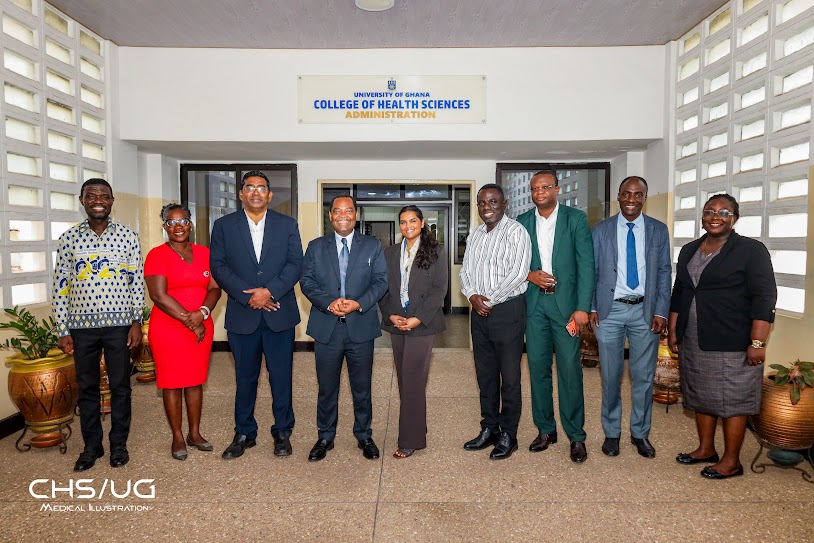
The College of Health Sciences (CHS) at the University of Ghana held high-level discussions with a delegation from Gulias College of Medicine, Philippines, on Tuesday, 10th November 2026, to explore opportunities for strategic academic collaboration aimed at expanding access to medical education and strengthening international institutional partnerships.
Chaired by the Provost of CHS, Prof. Alfred E. Yawson, the engagement provided a strategic platform for both institutions to examine potential areas of cooperation across medical education, curriculum development, faculty exchange, joint research, and student mobility.
Welcoming the delegation, Prof. Yawson underscored the University of Ghana’s unwavering commitment to internationalisation and global partnerships, as articulated in its 2024–2029 Strategic Plan. He emphasised the critical role of meaningful global alliances in advancing academic excellence, cutting-edge research, and institutional capacity building.
Leading the visiting delegation, the Chief Executive Consultant of Gulias College of Medicine, Ms. Katharina Pillai, noted that the proposed partnership seeks to address the surging demand for medical training, particularly among qualified applicants who are unable to secure admission due to capacity constraints in local medical schools. She highlighted Gulias College of Medicine’s 25-year track record in facilitating medical education for international students in the Philippines, noting that cohorts from several African nations including Ghana, Nigeria, Ethiopia, the Democratic Republic of Congo, and Cameroon have successfully benefited from its programmes.
A central focus of the deliberations was the feasibility of establishing a foundational or pre-medical programme in Ghana, enabling students to complete preparatory coursework locally before progressing to the Doctor of Medicine (MD) programme in the Philippines. Prof. Yawson observed that while the College continues to attract an overwhelming volume of applications for its medical programmes, admissions remain constrained by infrastructural and spatial limitations. He disclosed that during the previous admission cycle, approximately 3,700 applicants competed for limited slots, with only about 219 candidates gaining admission.
Recalling the College’s earlier vision of establishing a dedicated Biomedical College or Institute to provide foundational training for prospective students in medicine, pharmacy, and allied health disciplines, the Provost noted that this proposed collaboration offers a timely avenue to revisit that vision and create viable alternative pathways for qualified students.
Outlining the proposed academic model, the delegation explained that its pre-medical programme spans approximately 16 to 18 months and covers core foundational sciences, including Anatomy, Physiology, and Biochemistry. While noting structural parallels with the University’s Graduate Entry Medical Programme (GEMP), the delegation indicated that the proposed framework would also accommodate candidates entering directly from Senior High School.
Discussions further addressed the infrastructural and academic resources required to operationalise the initiative. The Gulias College of Medicine delegation expressed its readiness to explore capital investment in physical facilities, technology-enabled classrooms, laboratories, clinical simulation centres, and modern teaching aids. They proposed that the programme could initially leverage existing University of Ghana infrastructure supplemented by visiting faculty and technological support from the Philippines while long-term infrastructural developments are finalised.
The delegation also showcased its institutional capabilities in the Philippines, highlighting modern lecture theatres, specialised laboratories, clinical simulation suites, electronic examination platforms, digital libraries, and an affiliated teaching hospital, noting that its existing campus in Cebu has the capacity to accommodate approximately 5,000 students. Beyond foundational medical training, both parties expressed strong interest in broadening cooperation to encompass faculty and student exchanges, collaborative research, academic capacity development, and international knowledge transfer. In this regard, the delegation introduced its flagship Global Knowledge City project a 220-hectare educational hub in the Philippines designed to convene universities, scholars, and professionals globally and extended an invitation for the University of Ghana to participate through strategic academic and research partnerships.
To translate these discussions into actionable outcomes, Prof. Yawson proposed the constitution of a Joint Technical Committee, to be chaired by Prof. Nicholas Dayei, comprising representatives from relevant academic and administrative units of both CHS and Gulias College of Medicine. The committee is tasked with reviewing the curricula of both institutions, establishing academic equivalence, aligning admission and progression criteria, assessing infrastructural and staffing requirements, and recommending viable programme delivery models. Additionally, the committee will evaluate the institutional and regulatory approvals necessary to formalise the partnership and draft a comprehensive implementation framework for executive consideration.
In his closing remarks, Prof. Yawson commended the delegation for a productive engagement and reaffirmed the College’s resolve to advance the initiative. He urged the technical teams to commence deliberations promptly in order to identify practical, rigorous, and sustainable pathways toward formalising the partnership. The engagement marks a significant milestone in the College’s drive to foster impactful international collaborations, expand equitable access to medical education, and reinforce its leadership in health professions training and development.